Blog
How to Be Human on Your CV
AI is a great tool for writing a CV, but it shouldn't erase the person behind it. Here's what recruiters actually notice, and how to make sure your CV still sounds like you.

News
How to Be Human on Your CV
AI is a great tool for writing a CV, but it shouldn't erase the person behind it. Here's what recruiters actually notice, and how to make sure your CV still sounds like you.
How to Be Human on Your CV
How to Be Human on Your CV
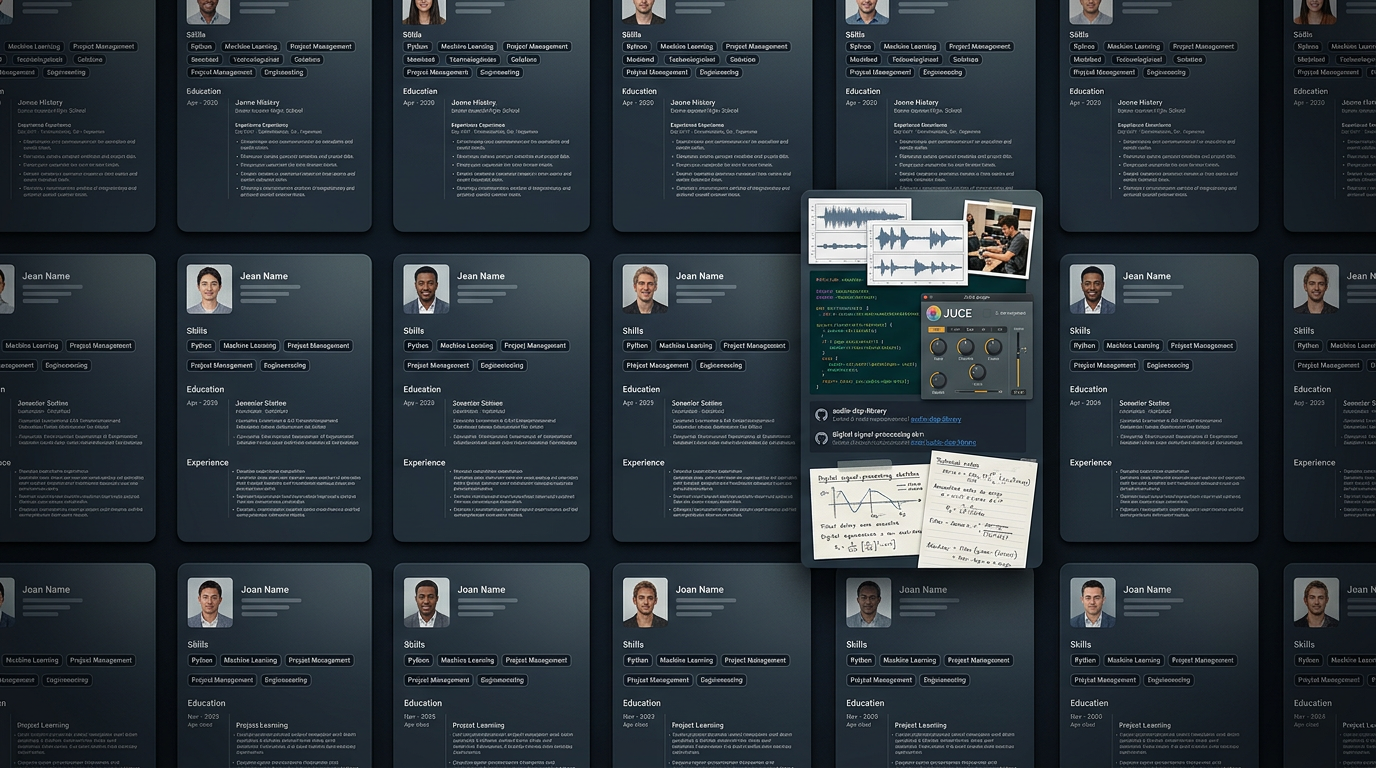
I read a lot of CVs. Audio developers, DSP engineers, plugin developers, graduates, twenty-year veterans. Over the last year or so, something has changed: a lot of them look identical.
Same template. Same font. Same section order. Same careful phrasing that mirrors the job description just a little too closely. That isn't because people have stopped trying. It's because a lot of people are asking the same tool for help, and it gives everyone the same answer.
I'm not against using AI to write a CV. It's genuinely useful for structure, for cutting waffle, for getting past a blank page. The problem is stopping there.
When a CV arrives with no trace of the person in it, I have nothing to work with, and neither does the client I'd be sending it to.
So here's what actually makes a CV read as human.
Make the template your own
Using AI to suggest your layout and section order is fine. Let it tell you what goes where. What you shouldn't do is take the whole thing, font and all, and send it as it came.
I see the same default template several times a day. It stops registering. Pick your own typeface. Adjust the spacing. If you want it to look considered, add a single highlight colour and use it sparingly, on your name or your headings. The CVs I remember are the ones where someone has clearly made a few design decisions of their own. It doesn't need to be beautiful. It needs to look like you made it.
Leave yourself some white space while you're at it. If everything is bold, nothing stands out, and a CV that's easy to scan will always beat one squeezing every last word onto two pages.
When you're sending it to a person directly, send a PDF rather than a Word document. A Word doc reflows on whatever machine opens it, so the layout you spent time on falls apart before anyone reads a word of it.
Write your opening section as a paragraph
Bullets are fine. I like bullets. Use them for your skills, your tools, your responsibilities.
But the section at the top, the personal statement or profile or however you label it, should be a proper paragraph in your own words. Two or three sentences. It's the only part of the document where you get to sound like yourself before the format takes over.
Put something in it that only you could have written. Not "passionate about audio software", which appears on roughly half the CVs I open, but what you've actually spent the last year building. If there's an outcome attached, better still: what you did, and what happened because you did it. Two sentences of that will do more for you than a paragraph of adjectives.
If you use AI to tailor your CV, read it before you send it
Tailoring your CV to a job spec is good practice, and I'd encourage it. Using a tool to help is fine.
But read what comes back, out loud if you can, and put it into your own voice. When a CV matches the job description almost word for word, and uses phrasing no engineer would ever say aloud, it reads as machine-generated. At that point I stop reading, and it goes no further.
Read it for accuracy too. AI has a habit of making people sound more experienced than they are, quietly promoting a module you contributed to into a system you owned. Check every line. If you wouldn't say it out loud in an interview, don't put it on your CV.
There's an irony worth sitting with here. The closer your CV gets to the exact wording of the spec, the less credible it looks. A CV that meets most of the requirements and sounds like a person will beat a perfect match that sounds like a bot.
Give me something I can verify
I need some way to check you're a real person: a LinkedIn profile, a GitHub, a portfolio site, something. Put it on the CV.
This isn't about follower counts or contribution graphs. When someone looks like an unusually good match for a role, the first thing I do is look for evidence of their work and experience. LinkedIn also shows me who we know in common, and in a field this small, that's often the quickest route to a real conversation about you.
If there's nothing at all to find, I can't put you forward with any confidence, and I won't send a client a candidate I can't stand behind. Not everyone can show their code, and if your work is proprietary I understand that. But a few real repositories will tell me far more than another unsupported line in a skills list.
Show me the things you actually make
This is where personality belongs, and it's where audio CVs are usually thinnest.
Link to a small site with your projects, even if they're personal. Especially if they're personal. A half-finished granular synth, a plugin you built for your own mixes, a band you record and produce for: all of it tells me something about how you think and what you care about. Finished projects are great, and interesting unfinished ones are often just as revealing.
Audio is a field people arrive at from music, from maths, from electronics, from live sound. That route is worth showing.
If you want an "about me" at the end, include one. Keep it short and make it specific. "I enjoy reading and going for walks" appears on so many CVs that it's become invisible. "I play double bass in a jazz trio and I've been slowly building a modular rig for five years" is memorable, and more usefully, it gives whoever interviews you something real to open with.
The test is simple: could this sentence sit on someone else's CV without changing a word? If yes, cut it or sharpen it.
Get other humans to advocate for you
The last one isn't about the document at all.
When a client gives us a job spec at The Audio Programmer, there are usually three to five people I contact straight away. Not because they applied that morning, but because I've spoken to them, I know what they're working on, and I can vouch for them. That's how we try to work, and it's the part of the process no CV can do on its own.
So talk to people. Go to meetups and conferences. Post about what you're building. Answer questions in the JUCE forum or the Discord. Have a conversation with a recruiter who works in audio before you actually need one.
The short version
None of this is about making your CV more elaborate. It's about making it less generic. Every point on this list answers the same question: is there a person here I'd put my name behind?
AI isn't going away, and nor should it. I use it most days. Just don't let it sand away the one thing on your CV that nobody else can claim: you.
If you're looking for your next role in audio, we'd love to hear from you.
Tessa Rowe
More Tutorials
We Built a Multi-Player Audio App With AI: Intro to Audiotool Nexus
Nexus is Audiotool's new extension layer that lets a browser-based app read and write a live project in real time, something a traditional VST can't do. Silas Gyger, lead engineer at Audiotool, shows how far an AI agent can take you by building three working apps from scratch.
More Meetups

The Audio Programmer Virtual Meetup | April 9th, 2026 @ 17:00 UK
Jani Huoponen, Scott Kramer, and Claus Trelby explore Eclipsa Audio – Google and Samsung's open-source spatial audio format – and what it means for creators working across music, film, TV, and the open web.
More News

More Articles

The audio industry is bigger than you think – and harder to hire into
Audio engineering has quietly fragmented across safety systems, embedded sensing, hearing tech and machine learning. The companies hiring in these fields are no longer just competing with other audio companies – and most of them don't realise it.