Blog
Launching Our Own Plugin with Moonbase
How we used Moonbase to launch BangZilla’s first plugin, from licensing and selling on our own site to making sense of the numbers afterwards.

News
Launching Our Own Plugin with Moonbase
How we used Moonbase to launch BangZilla’s first plugin, from licensing and selling on our own site to making sense of the numbers afterwards.
Launching Our Own Plugin with Moonbase
Launching Our Own Plugin with Moonbase
At The Audio Programmer, most of the plugins we work on belong to someone else. Helping people bring their ideas to life is a big part of what we love doing, but over the last year we’ve also been building something of our own.
Wave Theory is the first plugin from our new label, BangZilla. Launching it meant doing everything around the plugin ourselves: the website, the shop, licences, review copies, and making sense of the numbers afterwards.
Moonbase was one part of that, so here’s how we used it, and a few tips if you’re launching your own.
Why Moonbase
We first came across Moonbase around the end of 2024, when they were still a young company. Another developer we were working with had built an integration for one of his clients and recommended them to us. Since then we’ve used Moonbase on several client projects, as well as on the TAP site, where we sell our books, so by the time we launched Wave Theory, we knew the platform well.
Moonbase solves a very real problem for anyone selling audio plugins. Normally you’d need a shop, a customer account system and a licensing system, and you’d spend a lot of time keeping them talking to each other. Instead, you get all three in one place, with support for one-off purchases, subscriptions and rent-to-own, and payment by card, PayPal, Klarna and other local methods.
Practically speaking, one of the most useful things is that Moonbase is the merchant of record. They collect and pay the VAT and sales tax on every sale, wherever your customers are, so you don’t have to deal with international sales tax yourself.
We also like how close Tobias and the team are to the audio community. They keep a public feedback board where anyone can suggest features and comment on other people’s requests, and you can watch those ideas turn into real features. Email campaigns and automations are a recent example, which you can now run without a separate mailing service. That’s harder to find with a more generic platform that isn’t focused on audio.
If you want to hear the thinking behind the platform, Moonbase co-founder Tobias Madsen talked us through it on our podcast.
Licensing
On most projects, licensing is a chunk of work that someone has to own. On Wave Theory it was almost a non-event. When I asked Matthijs Hollemans, our lead developer, what he’d say about integrating Moonbase, he said:
“One of the nice things about Moonbase is that there isn’t too much to say. Integrating it is really easy, you just follow the steps from the repo, and it handles everything automatically. The only things I added were a button to open the Moonbase activation screen in the app, plus a link that shows up when there’s an update. Again, very simple, because Moonbase already gives you that info.”
The JUCE module covers trials, activation and update notifications. If you’re happy with Moonbase’s standard activation flow, integrating is quick. If you want something different, you can still do that, you’ll just be writing more of the code yourself.
You can change the colours, fonts and some of the wording on Moonbase’s screens inside the plugin, but if you want complete control over the licence activation process, you can use their backend API directly. Copy protection is up to you too. Moonbase focuses on licensing and selling, so if you want to add something like PACE alongside it, you can.
Selling from our own website
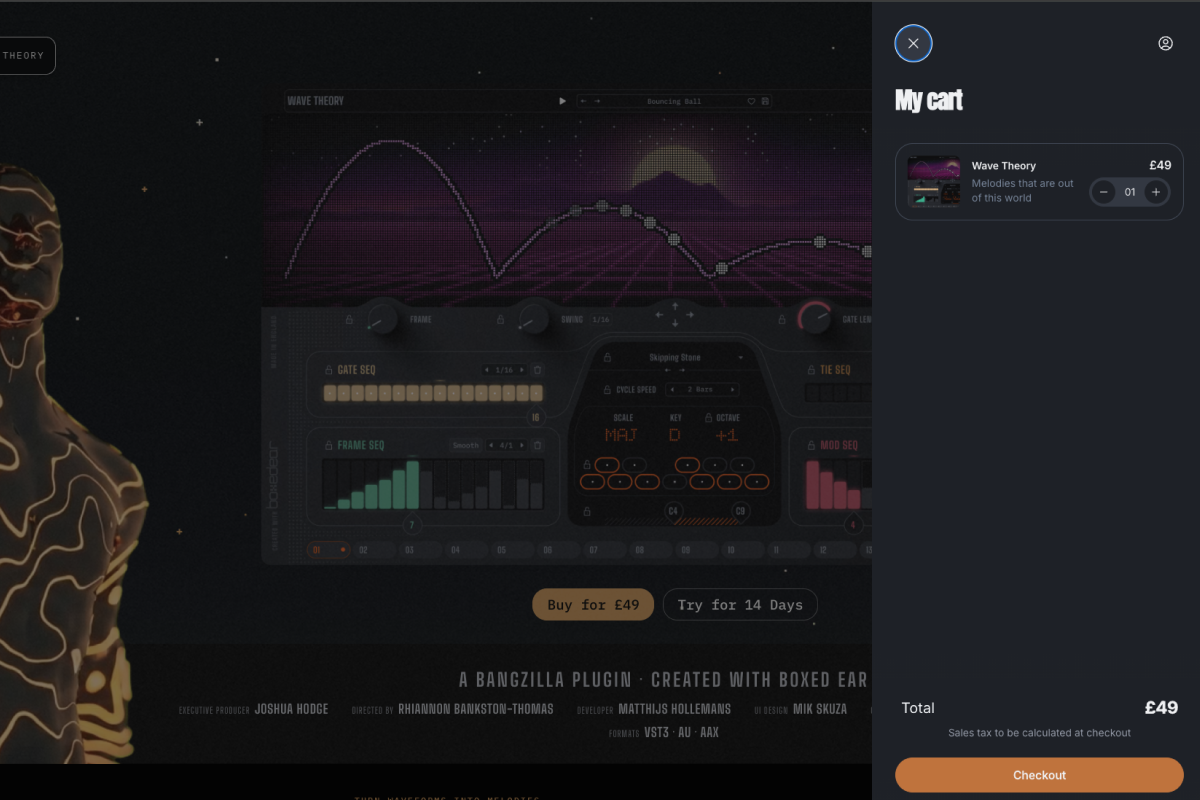
We built the BangZilla site in Webflow, like our main site, and wanted people to buy Wave Theory on the same page where they read about it and hear it. Moonbase’s embedded storefront made that straightforward. You add one script, then design your own buy buttons, and they pull in your Moonbase pricing in the customer’s currency. Checkout, accounts, licences and downloads all open over your own site, so buying feels like part of the page rather than a separate shop. Our experience is with Webflow, but it works with other website builders too, such as Squarespace, Framer and WordPress.
Sales are where the integration really shines. Once the buy buttons are set up to show discounts, you run a sale entirely from Moonbase, and the site shows the sale price with the old one crossed out until it ends. It’s worth knowing you can limit a promotion to visitors who arrive with a particular UTM tag, which is a handy way to check it privately before it goes live. A single promotion also takes the same percentage off everything in it, so if you want tidy prices on several products, give each its own discount.
Review copies and affiliates
Around a launch you send out a lot of free licences, to press, reviewers and friends of the project. In Moonbase these are vouchers, which each person redeems for a licence in their account. We found that people don’t always know the difference between a voucher and a discount code, and some will try to use a voucher at checkout, where it won’t work. Moonbase can open the redeem screen with the code already filled in, so we now send that link rather than a bare code, which saves a lot of back-and-forth emails.
From what we’ve seen, affiliates are easy to set up too. You give the creator their own coupon to share with their audience and set up an affiliate contract for their share of the sales. Moonbase then onboards them, collects their bank details and pays them once a month, and they get their own dashboard to see how they’re doing. One small thing to watch is that coupon names and descriptions show at checkout, so write them for the customer rather than for your own notes.
Reading the numbers
Because sales, licences and downloads all live in the same system, Moonbase’s dashboards show you the whole journey, from download to trial to purchase. UTM tags are recorded on trials as well as sales, so you can get a better picture of which videos, posts or campaigns are bringing people in.
It’s worth taking a moment to understand what each number counts. Download figures include people with free licences, your own team and buyers downloading what they’ve paid for, so a download-to-trial rate taken at face value will look worse than it is. Plenty of buyers skip the trial altogether, too, so trials are only part of the picture.
You can also choose whether people need an account before they download or start a trial. It means you know who’s downloaded your plugin, but anyone who stops at the sign-in screen won’t show up in your numbers, so it’s a trade-off to think about. And tag your links, or a lot of your traffic will show up with no known source.
Looking back
Having the idea, building the plugin and testing it can feel like the hardest part, but then you have to think about everything else around it, so it’s worth making some of that easier on yourself. Moonbase took a lot of the selling side off our plate, so we could spend more of our time on the plugin and on telling people about it.
If you have a plugin idea, or a prototype you’d like to turn into a commercial release, we can help with every step, from development through to launch. Get in touch.
Moonbase sponsors The Audio Programmer’s virtual and in-person meetups.
Rhiannon Bankston-Thomas
More Tutorials

We Built a Multi-Player Audio App With AI: Intro to Audiotool Nexus
Nexus is Audiotool's new extension layer that lets a browser-based app read and write a live project in real time, something a traditional VST can't do. Silas Gyger, lead engineer at Audiotool, shows how far an AI agent can take you by building three working apps from scratch.
More Meetups

The Audio Programmer Virtual Meetup | April 9th, 2026 @ 17:00 UK
Jani Huoponen, Scott Kramer, and Claus Trelby explore Eclipsa Audio – Google and Samsung's open-source spatial audio format – and what it means for creators working across music, film, TV, and the open web.